BNP Paribas Real Estate, the European leader in real estate services for both companies and individuals, is releasing the results of a groundbreaking European survey conducted with IFOP. We asked 3,500 employees in seven European countries about their hopes for office space in the future. Far from being just a trend related to the health crisis, the study shows that hybrid work is becoming more established. The reasons for going to the office are now quite specific: a dynamic and accessible environment, greater connectivity, a friendly atmosphere, etc. The main lesson from this survey is that responses differ greatly between countries, but also between generations.
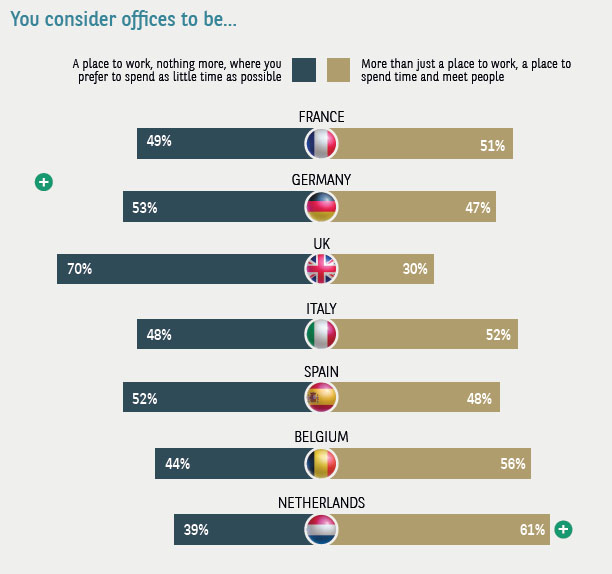
A place to work or spend time? Europeans divided on the role of the office For the past two years, the working environment has been multi-layered, combining office, home and third space. The lack of interaction and health restrictions have altered the playing field and redefined the role of offices for those who work in them. In the Netherlands (61%) and Belgium (56%), the office should above all be a place to exchange ideas, socialise and work together - a view shared by more than one in two French people (51%).
For the past two years, the working environment has been multi-layered, combining office, home and third space. The lack of interaction and health restrictions have altered the playing field and redefined the role of offices for those who work in them. In the Netherlands (61%) and Belgium (56%), the office should above all be a place to exchange ideas, socialise and work together - a view shared by more than one in two French people (51%).
Conversely, 70% of UK employees consider thatoffice the office is nothing more than a worplace, where as little time as possible should be spent - way ahead of Germany (53%) and Spain (52%), where the majority also share this view.
The new role of the office also divides generations. Unsurprisingly, most young Europeans (under 30) appreciate its human and social aspects: this is particularly the case in Italy (69%), France (66%), Germany (59%) and the UK (57%). On the other hand, it remains chiefly a place of work for employees aged between 30 and 49 in France (54%), Germany (57%), and the UK (70%).
“The sudden prevalence of hybrid work has prompted us to question the traditional role of the office. The partitioned unit is a thing of the past, we must now constantly “re-enchant” it to offer what telework perhaps cannot. This means offices, of course, but also places to receive guests, to learn, to have a social experience, etc. To turn it into a real destination” says Sylvain Hasse, Head of Corporate Services for BNP Paribas Real Estate.
High expectations for more service-based offices After two years of the health crisis, European workers are clear about what they now want from their workplaces. In France, services (shops, gym, concierge service, etc.), either inside or just next to the office, are an essential criterion (50% of respondents) - on a par with Germany. These needs were also expressed in Italy and Belgium (47%) - but were not a priority for the Dutch (34%).
After two years of the health crisis, European workers are clear about what they now want from their workplaces. In France, services (shops, gym, concierge service, etc.), either inside or just next to the office, are an essential criterion (50% of respondents) - on a par with Germany. These needs were also expressed in Italy and Belgium (47%) - but were not a priority for the Dutch (34%).
In the UK (53%) and Italy (49%), the top criterion is equipment: employees are most interested in being well equipped with good connectivity. Unsurprisingly, accessibility by public transport is still an important criterion for all European employees (41% on average). Interestingly, the provision of soft mobility (car-sharing, electric bikes, scooters, etc.) is considered essential by 21% of French employees - ahead of their counterparts in the UK (13%), the Netherlands (15%) and even Germany (19%).
As for how workspaces should be designed, opinions differ. While the UK favours private and individual concentration spaces (53% vs. 43% for group workplaces), Spain prefers areas that encourage teamwork (56% vs. 32% for individual spaces). At the same time, the Netherlands encourages both types (55% for individual spaces, 54% for group work), and even flex-office (45%).
In France, opinions are fairly divided between private spaces (46%) and collaborative workspaces (44%). But one thing is certain: 46% require social areas (cafes, cafeterias, lounges, etc.), topping all countries surveyed.
“The survey clearly shows that we are at a tipping point for commercial real estate, where the quality of the spaces and services offered by companies is essential to both retaining employees and attracting new talent. Apart from the office, this also implies a more mixed, flexible and sustainable vision of the urban landscape” remarks Séverine Chapus, deputy general manager for Development at BNP Paribas Real Estate.
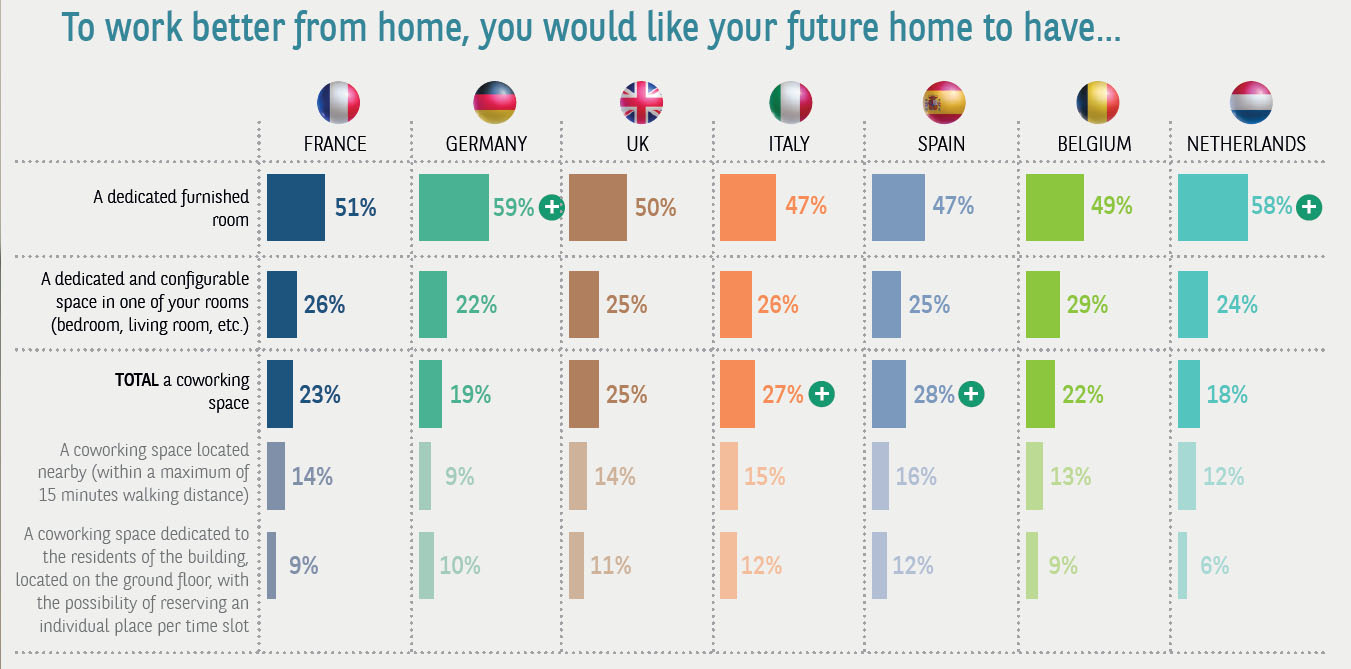
Working from home: European employees prefer a dedicated room One thing is certain: the home office will last beyond the health crisis, and these new habits will require special arrangements to set up a suitable alternative office at home. But how do European employees want to organise their future homes to improve how they work in them?
One thing is certain: the home office will last beyond the health crisis, and these new habits will require special arrangements to set up a suitable alternative office at home. But how do European employees want to organise their future homes to improve how they work in them?
All countries surveyed preferred a dedicated room. This is the preferred option of 59% of German employees, 58% of Dutch, and 51% of French. The second most popular arrangement is flexible space in one of the rooms of the home (bedroom, living room, etc.), followed by coworking spaces - which appeal to 23% of French people.
Although there are differences between countries, preferences for housing layouts seem to be determined more by the age of the respondents. Indeed, the over 50s seem to be particularly keen on having a separate room: 71% in Germany, 55% in the UK and 54% in Italy.
Those under 30, especially in the Netherlands, Belgium and the UK, are more attracted to working in a coworking space than older cohorts. We also note that the employees who are most open to coworking spaces are those who are used flex-office arrangements.