
The European office market continues to face a challenging environment, characterised by moderate economic growth, geopolitical uncertainty and persistently high interest rates. Against this backdrop, occupiers and investors remain cautious. While leasing activity remains under pressure and rising yields are once again weighing on capital values, office investment is showing a degree of resilience, with volumes up 7% over the first nine months of the year. The market is becoming increasingly selective and polarised, with demand continuing to focus on prime assets in the best locations.
Take-up remains subdued
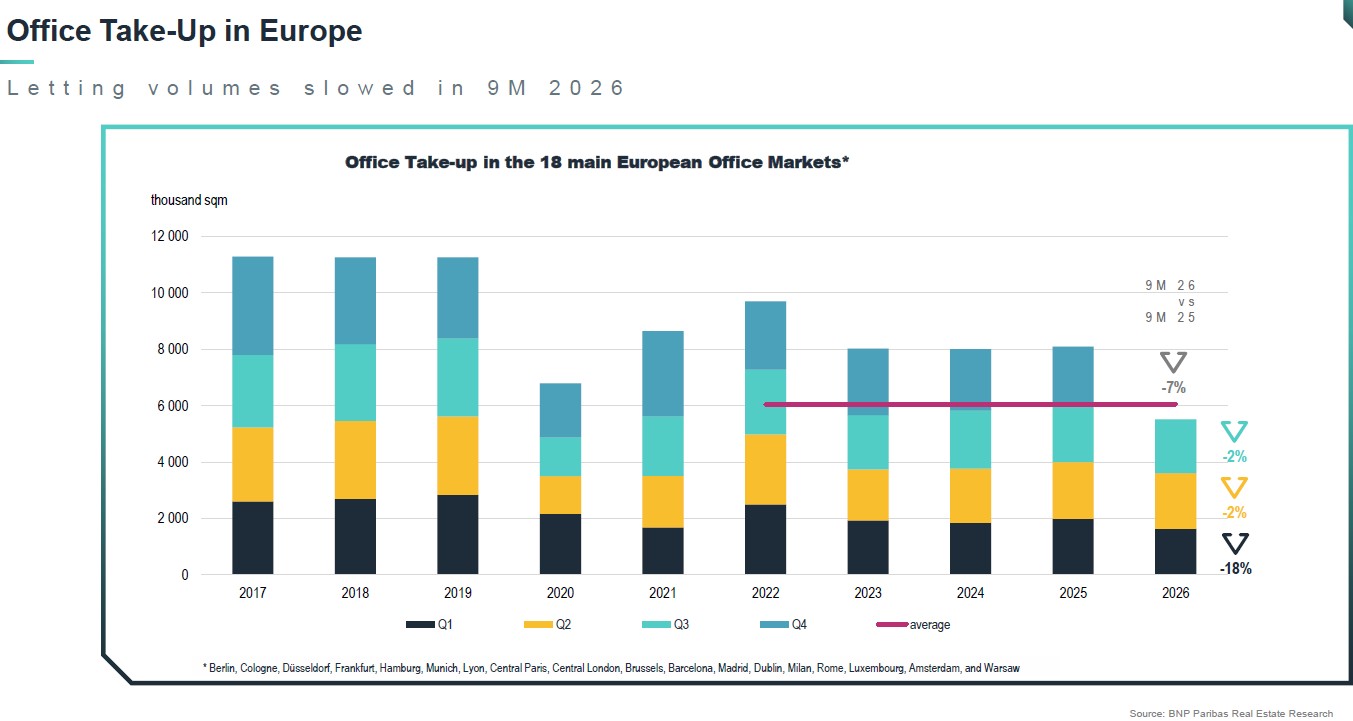
In the third quarter of 2026, leasing activity slowed slightly across Europe, with take-up down 2% compared with the third quarter of 2025. Over the first nine months of the year, take-up reached 5.51 million sqm across the 18 main European markets*, down 7% year-on-year and 9% below the five-year average. This trend notably reflects a decline in large transactions across many markets. In an economic and financial environment that remains uncertain, occupiers continue to exercise caution, increasingly favouring smaller spaces and higher-quality buildings.
Trends nevertheless vary considerably across Europe’s major markets.
In Paris, take-up fell by 18%, weighed down by a decline in transactions above 5,000 sqm (-30%), while the small and medium-sized segment proved more resilient (-8%).
London also recorded a 6% decline, although the 771,000 sqm of take-up remains 6% above the five-year average. The market particularly benefited from large transactions, with 22 deals above 5,000 sqm recorded since the beginning of the year.
The six main German markets remained broadly stable (-1%), although disparities between cities remain significant. Berlin and Munich stood out, with year-on-year increases of 49% and 19% respectively, taking activity to 12% and 8% above their respective five-year averages. This momentum was notably supported by several large transactions, including significant owner-occupier deals. Conversely, take-up fell by 12% in Hamburg and 40% in Frankfurt, where healthy activity in the mid-sized segment was insufficient to offset the absence of major transactions.
Elsewhere in Europe, performance was similarly mixed. Amsterdam (-41%), Milan (-19%) and Madrid(-11%) recorded significant decreases, while Brussels (+22%) and Warsaw (+19%) posted increases.
Moderate rise in vacancy masks significant disparities
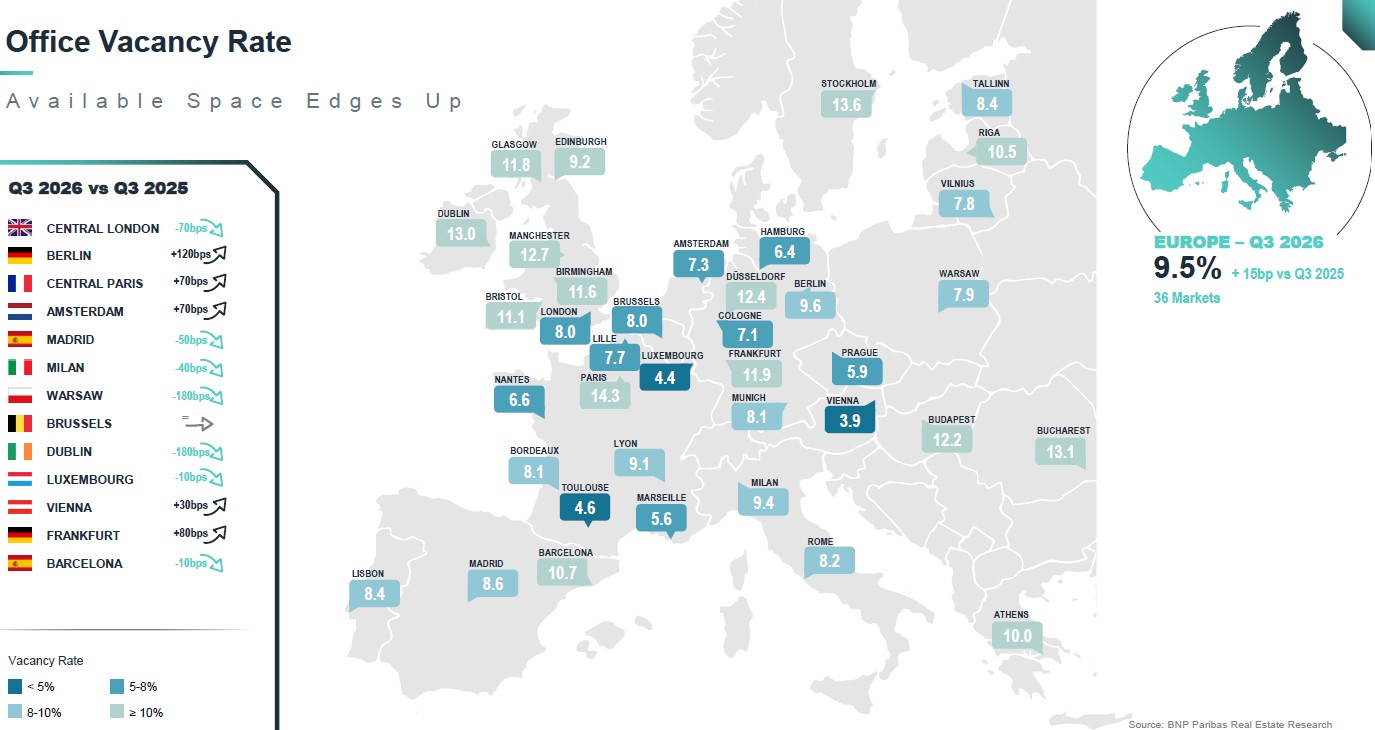
Availability of office supply in office supply in Europe continues to increase, albeit at a more moderate pace and with considerable variations between markets. At the end of September 2026, the average vacancy rate stood at 9.5%, up 15 basis points year-on-year. This increase primarily reflects weaker leasing demand rather than an increase in new supply, as development volumes remain limited and a
significant proportion of projects currently under construction have already been pre-let. Several markets nevertheless recorded lower vacancy rates, including Madrid, Milan, Warsaw, Dublin and Central London.
Vacancy rates also remain highly polarised within individual markets. Supply is particularly limited in the most sought-after central business districts, with vacancy rates of just 0.9% in central Barcelona, 1.1% in Rome, 3.4% in Milan and 3.5% in Munich. By contrast, vacancy continues to rise in many peripheral submarkets, where demand is weaker and available supply is less well aligned with occupiers’ current requirements. The Paris CBD (7.2%, +195 basis points year-on-year) is an exception among central locations, with vacancy rising significantly as a result of recent completions.
Prime rental growth remains robust
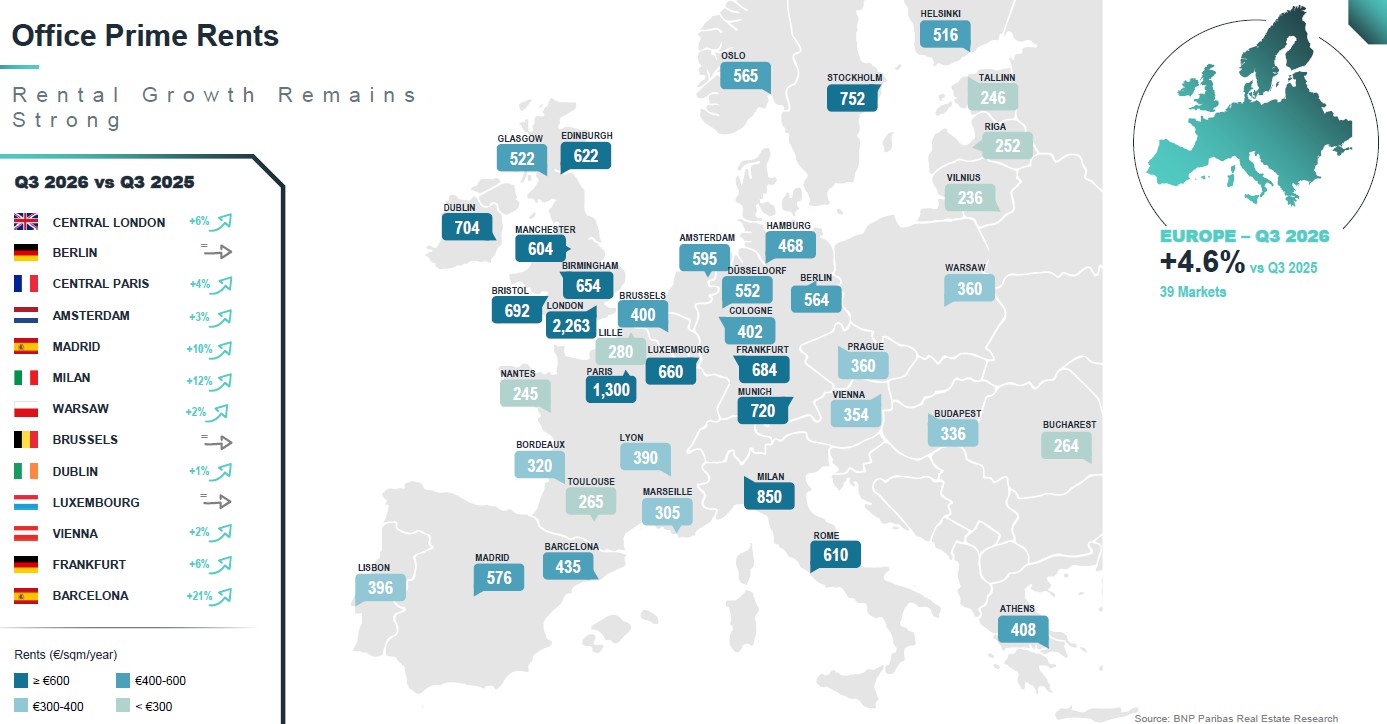
Prime rents continue to rise across most major European cities, supported by the persistent shortage of new supply and sustained demand for high-quality buildings in the most sought-after locations. Over the past 12 months, the strongest increases were recorded in Barcelona (+21%), Milan (+12%), Madrid (+10%) and Munich (+9%).
“Despite the continued rise in rents, real estate strategies remain largely driven by the need to attract and retain talent, rather than by the sole objective of reducing real estate costs. The growing shortage of modern space in central locations could, however, encourage some occupiers to consider more affordable peripheral locations, provided these offer good transport connectivity and an attractive environment for both businesses and their employees,” explains Etienne Prongué, Head of International Investment Group (IIG) at BNP Paribas Real Estate.
At the same time, average rents are showing more mixed trends and could come under greater pressure in the months ahead, particularly for secondary assets and peripheral locations, which are more exposed to the slowdown in demand.
Investment enters a prolonged phase of caution
The European real estate market has entered an era of heightened vigilance, against a backdrop of persistently high interest rates. While liquidity has tightened considerably, it has not disappeared, allowing a steady but limited flow of transactions to continue. The European investment market is therefore experiencing a slowdown in 2026, as property yields react to continued volatility in the bond markets.
At the end of September, year-to-date investment volumes stood at €118 billion, stable year-on-year. Activity nevertheless lost momentum, particularly in the third quarter, while transaction completion times have tended to lengthen. This slowdown reflects increased investor caution, as investors seek greater visibility on pricing and the outlook for monetary policy before committing.
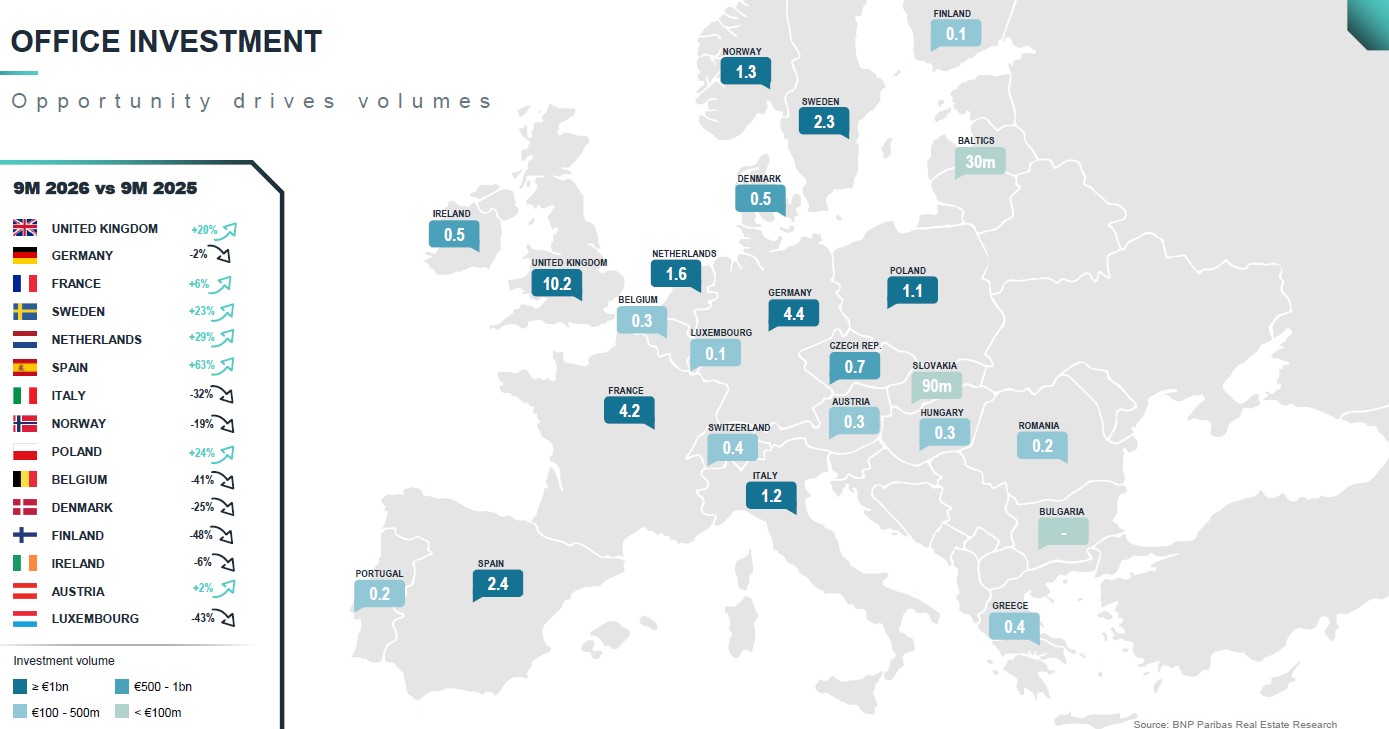
Despite this environment, the office sector has performed more favourably, with close to €33 billion invested during the first nine months of the year, up 7%. The market is therefore showing a degree of resilience, in contrast with the stable performance recorded across the European investment market as a whole.
Following a challenging period, characterised in particular by a later pricing adjustment than for other asset classes, the office sector is gradually adapting to new market realities, although visibility remains limited.
Over the first nine months of the year, trends varied significantly between markets:
The UK emerged as one of the main drivers of European growth, with investment activity up 20%. The London market has maintained consistent and sustained momentum for almost two years.
France recorded a 6% increase following a quieter start to the year. This performance was driven by a particularly active third quarter, with more than €2 billion invested, accounting for 50% of the volumerecorded since the beginning of the year, despite market sentiment remaining cautious.
Momentum in these two markets was notably supported by several transactions exceeding €500 million, including the disposals of two London assets by Canary Wharf Group and the sale of the Capital 8 business centre in Paris’s 8th arrondissement.
Germany recorded a slight decline (-2%), affected by a quieter third quarter following signs of improvement during the first half of the year. In this environment, offices nevertheless delivered thestrongest relative performance among the main asset classes.
The Spanish market confirmed its upward trajectory, with investment volumes reaching €2.4 billion, up 63% compared with the same period in 2025. This momentum was evident in both Madrid and Barcelona, where activity remained well above the five-year average, by 60% and 70% respectively.
Continuing the upward trend observed over the past three years, the Netherlands recorded a 29% year-on-year increase, with €1.6 billion invested since the beginning of 2026, 14% above the five-year average.
While investment activity in Italy contracted by 32% year-to-date, the market continues to demonstrate a degree of resilience. Milan remains the country’s leading market, while strategic transactions, such as the sale of Palazzo Esedra in Rome, demonstrate persistent demand for prime assets.
The Polish office market has been in a normalisation phase for the past two years. Activity nevertheless remains positive, with more than €1 billion invested since the beginning of the year, representing a 24% increase.
In Ireland, activity is showing signs of losing momentum following the improvement seen previously. Nevertheless, the market continues to record a certain level of activity, with close to €500 million invested.
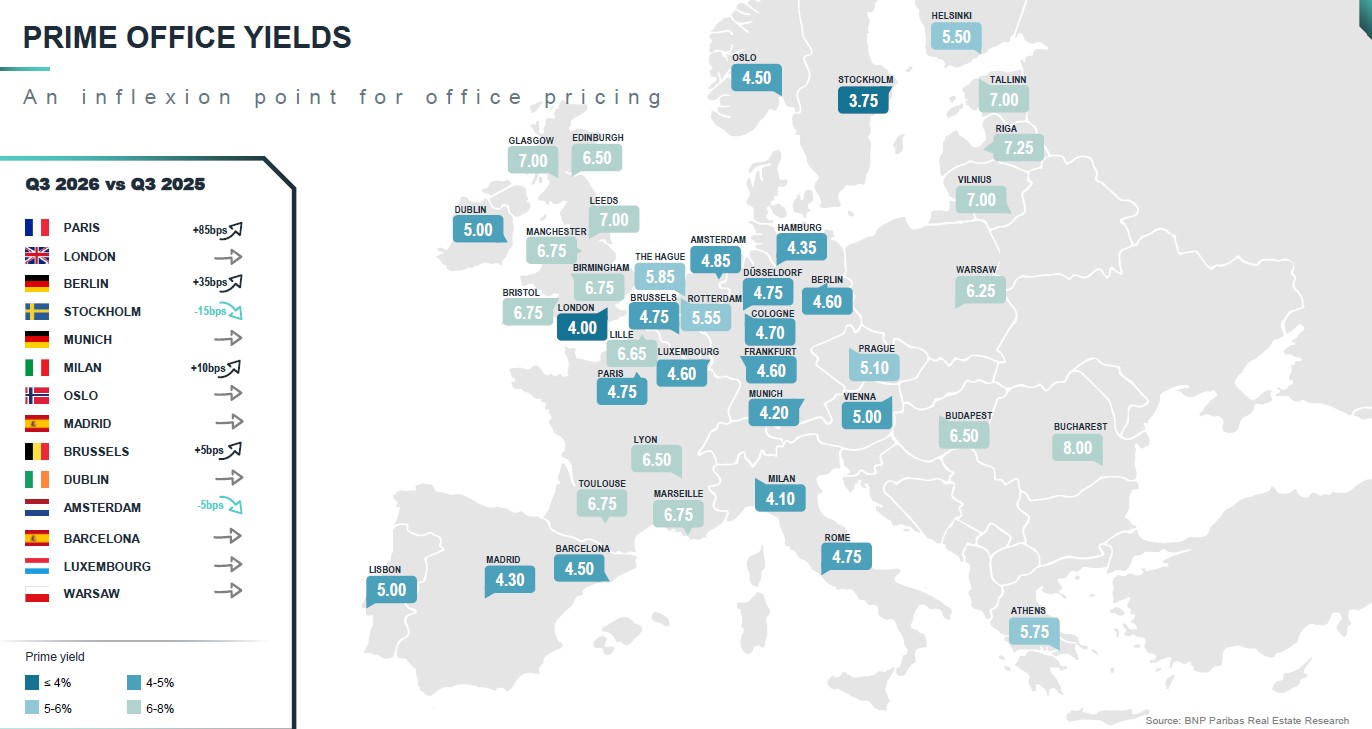
Following a brief period of resilience, office yields are rising again
Volatility in government bond markets, exacerbated by persistent inflationary pressures, has increased once again. The German Bund, in particular, has climbed towards historical highs, illustrating the volatility affecting bond markets. Against a backdrop marked by the crisis in Iran and unpredictable energy costs, the ECB has been prompted to tighten monetary policy, with two consecutive 25-basis-point rate increases since June.
In this environment, the outward movement in real estate yields has become more widespread and now affects a large number of European markets. The trend is particularly pronounced in France, where the movement that began in Paris in the third quarter of 2025 has now spread to regional markets. In Germany, the picture remains more mixed: while Berlin, Frankfurt and Düsseldorf have recorded
adjustments, Munich stands out as an exception, with prime yields remaining stable.
“Although the significant repricing that has taken place since 2022 is now providing a degree of cushioning, the narrowing spread with government bond yields suggests that further price adjustments may lie ahead. The European market nevertheless remains attractive despite a more challenging environment. Investors remain cautious as they wait for greater visibility, while Europe’s
major markets continue to demonstrate their resilience,” explains Etienne Prongué, Head of International Investment Group (IIG) at BNP Paribas Real Estate.
Against this backdrop, investors are prioritising best-in-class assets at the heart of Europe’s major
markets. This shift towards prime assets, supported by resilient rental values in the best locations, is
helping to mitigate the impact of interest rate pressures and preserve the attractiveness of the
European office sector.
*Berlin, Cologne, Düsseldorf, Frankfurt, Hamburg, Munich, Lyon, Central Paris, Central London, Brussels, Barcelona, Madrid,
Dublin, Milan, Rome, Luxembourg, Amsterdam and Warsaw.

