
Czech Republic: coworking is expanding also outside of Prague
Flexibility, community and services, those are three key pillars of the coworking centres´offer that attract more and more users. Coworking centers cater for the needs of startups or freelancers and offer creative spaces and flexibility not just for the millennials. They provide the clients with a a variety of membership options, from virtual membership to access to space 24/7. Coworking centres enable networking and connect individuals and firms in a creative and inspiring environment within the network of centres and organized events. Members can use a wide range of services from the use of the café or kitchenette up to renting an electric car.
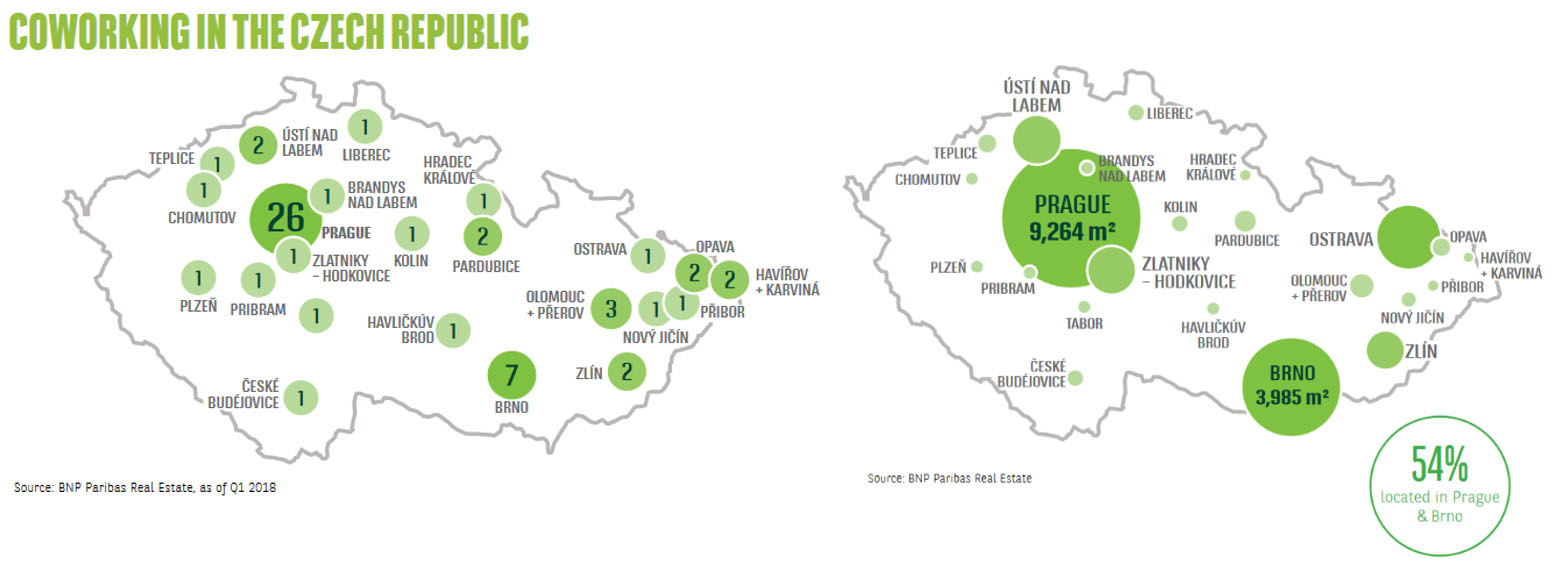
According to the international real estate advisory, BNP Paribas Real Estate, there are 61 coworking centres in Czech Republic, 26 are situated in Prague. Total size of the centres currently in operation stands at 19,000 sq m. In addition, BNP Paribas Real Estate records 18,000 sq m of serviced offices.
“In Czech Republic, in Prague most of the coworking concepts are situated in the city centre, followed by Prague 5 and Prague 2. Moreover, coworking centres are being opened in other cities and not just the large regional capitals but cities like Příbram, Nový Jičín, Chomutov, Teplice či Přerov,” lists Lenka Šindelářová MRICS, Head of Research & Consultancy at BNP Paribas Real Estate Czech Republic.
Dynamic growth of this sector is demonstrated by the entry of some large international chains to the Czech office market. BusinessLink will open its new centre in Visionary building in Prague 7 by the end of this year. HubHub will start operation of its 2,000 sq m centre in Na Příkopě street and open a second centre by the end of the year. International Workspace Group (IWG - holding company of Regus, Spaces and other coworking brands) will be opening this year in Albatros Building Prague 1 on 3,500 sq m. Also, operators already present locally are expanding. Impact Hub has recently opened a branch in Brno on 3,400 sq m the largest in its European network. Last year Node5, another of operators, made coworking space available in Ústí nad Labem with a total size of 750 sq. m. In the remainder of this year 13,000 sq m of coworking centres will be opened, representing a 65% year on year increase.
In 2002 the first coworking spaces were opened in Denmark and Austria, in US the term coworking space was used officially for the first time in 2005. From that moment the phenomenom experiences a worldwide boom. In Europe, Spain is the country with the highest density of coworking spaces per inhabitant. The other leading countries are France, Germany, Italy and Poland.
As reported last year by international advisory company BNP Paribas Real Estate, the global amount of functioning coworking spaces reached 14,000, with number of users exceeding 1,2 million. Analytics from BNP Paribas Real Estate assume that until 2020 there will be twice as many active spaces and even the amount of the users will triple. Expansion of coworking offices reacting to the millennial generation entering the market also concerns Czech Republic. It may impact the special patterns. Currently the majority of centres has been situated in B-C class properties (93%). Recently the share of coworking centres in A class buildings has risen to 7% and it will continue to grow with new spaces run by international companies being opened. The planned openings are visibly larger than centres opened until now with average size of 320 sq m.
The concept of coworking spaces will gradually change. There is a stronger emphasis on professionalization of operators. It is estimated that in the future, changes will occur in terms of sector or focus, centres will get specialised for particular groups such as lawyers, marketers or e-commerce. More services will be offered by hubs including: accounting or business advisory, mentoring, training and counselling of members. Many operators use conferences and trainings as a substantial source of revenues; this trend might even strengthen in the future.
International coworking centres will complement the standard mix in modern office schemes and help them attract large corporate tenants, who want to be close to the talents. A large part of coworking centers will continue to seek post-industrial, older spaces with unique atmosphere and genius loci, through which they will support the revitalisation of formerly neglected buildings.
